Digital Dominance and Electoral Reality: Telangana's Three-Way Power Struggle Online
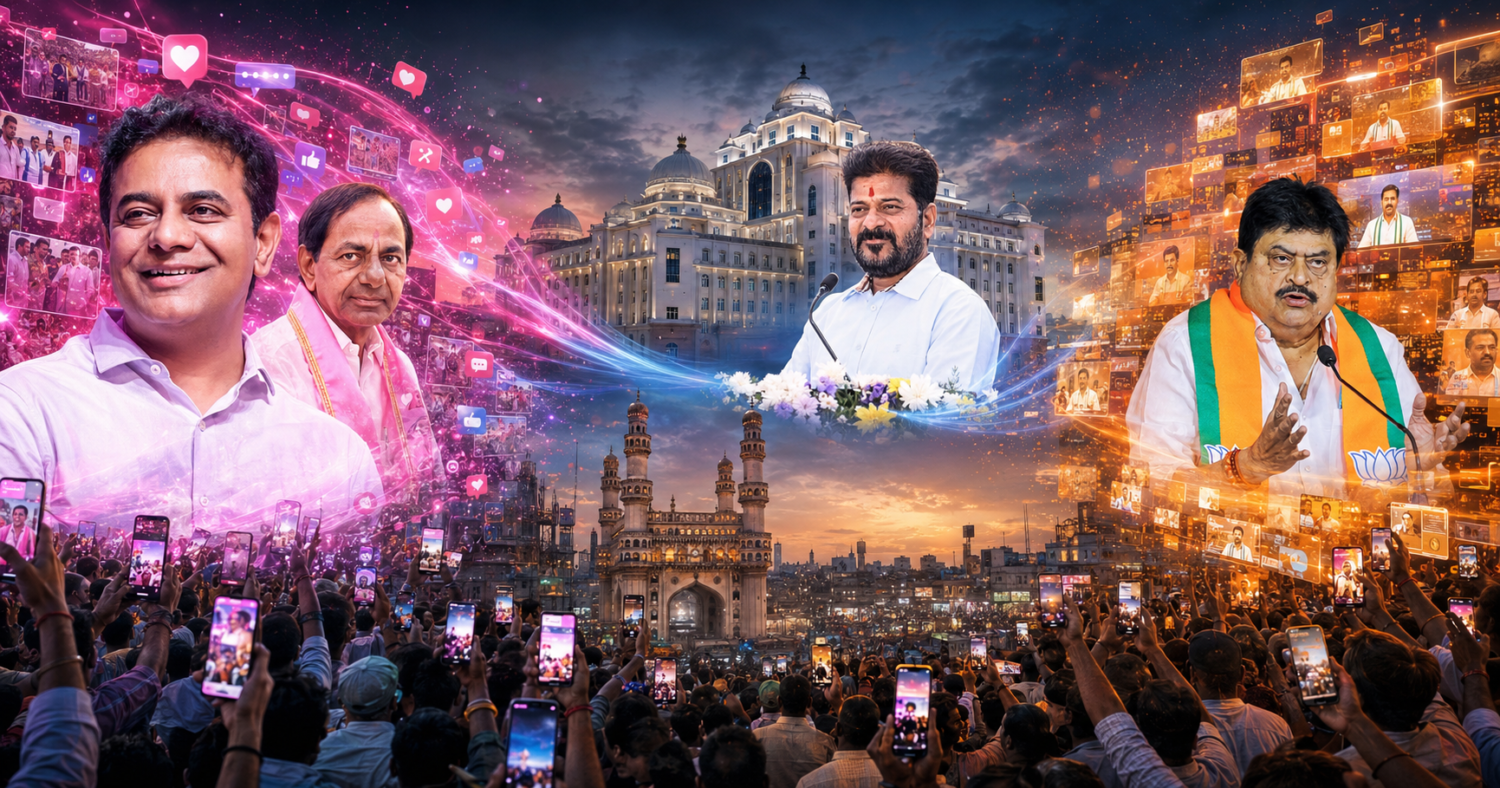
When Anumula Revanth Reddy took the oath of office as Telangana's second Chief Minister on December 7, 2023, at Lal Bahadur Shastri Stadium, massive crowds gathered to witness the moment. Yet beneath the ceremonial proceedings, another shift in power—less visible but equally significant—was already underway. This digital transformation would take months to fully materialize, and its effects continue to reverberate more than two years later.
Unlike the stadium handover, this transition remains contested and complex. Since December 2023, Telangana's political landscape has been shaped by how three parties—the Bharat Rashtra Samithi (BRS), the Indian National Congress, and the Bharatiya Janata Party (BJP)—have each answered a fundamental question: what does winning on digital platforms mean in modern politics?
The Numbers Tell a Striking Story
The scale of digital presence varies dramatically across the three parties. BRS, which has not held power for over two years, commands 942,000 followers on X, 1.24 million likes on Facebook, 632,000 Instagram followers across 29,000 posts, and approximately five million YouTube views monthly. These figures represent the strongest digital footprint in state politics. Remarkably, BRS has not spent a single rupee on Google or YouTube advertising since losing the election—every engagement is entirely organic, built through content creation and the considerable influence of working president K.T. Rama Rao.
Congress entered power with electoral momentum but initially trailed in social media metrics. Its Telangana Facebook page had 349,000 likes, less than a third of BRS's figure. While its X presence existed, it remained inconsistent, and Instagram engagement lagged behind the opposition. However, Chief Minister Revanth Reddy's personal Instagram account, cultivated during the campaign, now reaches one million followers—the highest individual politician presence in the state. Beyond personal accounts, Congress possesses the machinery of government itself, generating daily announcements, inaugurations, and welfare program updates that opposition parties cannot replicate.
BJP's organic digital base appeared smaller initially: 707,000 Facebook likes, 374,000 Instagram followers, and a developing YouTube channel. Yet the party compensated aggressively through paid advertising. Between December 7, 2023 and June 2026, BJP ran 244,813 ads on Google and YouTube platforms in Telangana, spending ₹6.34 crore—averaging just ₹26 per ad. This micro-targeted, high-volume strategy reflects the national BJP digital machinery's focus on Telangana after the party's strong 2024 Lok Sabha performance, winning eight of the state's 17 seats.
Pre-Election Spending Painted a Different Picture
The pre-election period revealed contrasting priorities. Between June 2023 and January 2024, BRS spent ₹9.95 crore across 243 Google and YouTube advertisements. Congress invested ₹7.36 crore across 520 ads. BJP spent ₹62 lakh across 1,689 ads. BRS's higher per-ad spending suggested premium placements and longer video formats, while BJP favored scatter-shot micro-targeting. Despite BRS's superior spending, Congress won the election—a crucial reminder that digital dominance does not guarantee electoral victory.
Strategic Reinvention Across Three Fronts
The data from the past two and a half years reveals more than a simple disconnect between online reach and political power. It demonstrates three parties undergoing profound strategic transformation in response to a dramatically altered political environment.
BRS transitioned from governing party to opposition overnight, losing institutional voice through government press releases and official ministry social media handles. Rebuilding its communications operation entirely on organic foundations, the party has maintained substantial follower counts and engagement without paid promotion—testament to the digital infrastructure built during its decade in power. This success carries risks, however, particularly the dangerous concentration of the party's entire online identity in a single individual.
Congress confronted the opposite challenge: leveraging the institutional megaphone while preserving the insurgent energy that powered its campaign. The transition has been uneven. A January 2025 Twitter poll by the @INCTelangana handle invited comparisons between former Chief Minister K. Chandrasekhar Rao's governance and Revanth Reddy's "Praja Palana," with voters favoring the former—an unforced error revealing the distinct skill sets required for campaign versus government social media management.
BJP has pursued a different path entirely. The party methodically builds digital presence through advertising volume that far exceeds its organic reach, establishing message recall and name recognition through spending that dwarfs rivals. Whether this investment yields electoral gains in 2028 remains the most compelling question in Telangana politics today.
What Lies Ahead
These divergent trajectories offer insight into how political power operates in the social media age. The coming months will reveal whether digital spending translates into votes, whether organic reach sustains political movements, and whether government resources provide lasting advantage. For Telangana, the answer will shape not only the state's political future but offer lessons for democracies navigating the intersection of digital platforms and electoral politics.
Compare options


