TDP's Rajya Sabha Entry Spotlights Mangalagiri's Struggling Handloom Heritage
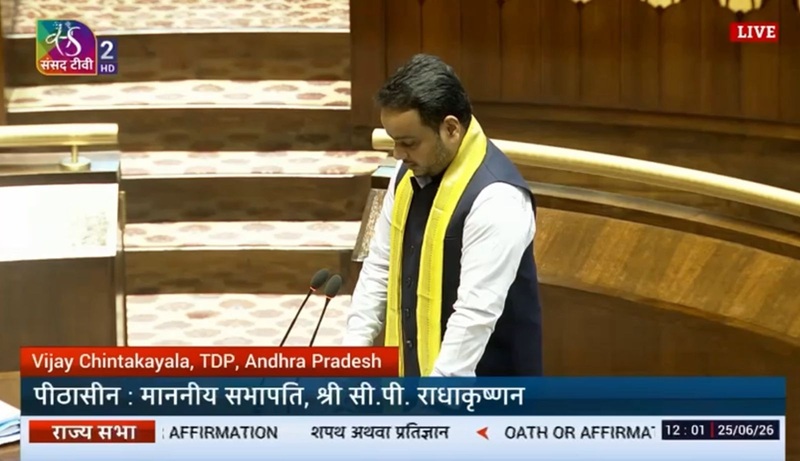
Andhra Pradesh marked a significant political moment as the Telugu Desam Party strengthened its presence in the nation's upper house. On June 25, Vijay Chinthakayala Ayyannapatrudu was sworn in as a Rajya Sabha member alongside fellow TDP legislators Sana Satish Babu and Bhashyam Rama Krishna, along with Jana Sena Party's Lingamaneni Ramesh, consolidating NDA gains in the chamber.
The occasion carried deeper resonance through Chinthakayala's choice of attire—a handwoven Mangalagiri cotton shawl, the ceremonial garment bearing witness to one of Andhra Pradesh's most celebrated textile traditions. The selection was deliberate, channeling attention toward the historic weaving community centred in the Guntur district temple town.
Mangalagiri's association with fine cotton weaving stretches back more than five centuries. Historical records trace the craft's roots to the Qutub Shahi era, when punitive taxation on handloom goods in 1593 prompted numerous weavers to abandon the region entirely. Despite this early devastation, the tradition persisted through successive generations, adapting and evolving across centuries. Contemporary recognition came through Geographical Indication status, affirming the distinctive character of Mangalagiri's weaving methods and materials.
Yet beneath this celebrated legacy lies a troubling trajectory. The 1990s witnessed approximately 20,000 active weavers working in Mangalagiri. Current figures reveal a precipitous decline to roughly 6,000 practitioners. Economic pressures—rising production costs, compressed profit margins, and proliferation of factory-produced alternatives—have systematically eroded the community's sustainability.
Chinthakayala's sartorial statement thus carried symbolic weight extending beyond ceremonial convention. His choice reflected commitments articulated by TDP Minister Nara Lokesh, who represents the Mangalagiri Assembly constituency and has positioned himself as an advocate for the weaving community. "Weavers are not workers. They are craftsmen. It is a God-given skill," Lokesh stated, emphasizing the distinction between industrial labour and artisanal practice. In 2019, he announced a Rs. 250 crore intervention initiative designed to support international market positioning for Mangalagiri textiles. "It will be my responsibility to attend the grievances of each and every weaver," he committed.
As Chinthakayala took his oath draped in the handwoven fabric, the garment embodied aspirations of thousands of weaving families, the accumulated wisdom of a centuries-long craft tradition, and an implicit pledge that Mangalagiri's artisans would find representation in India's highest legislative spaces.
Compare options