RBI Holds Repo Rate at 5.25% While Trimming FY27 Growth Projections
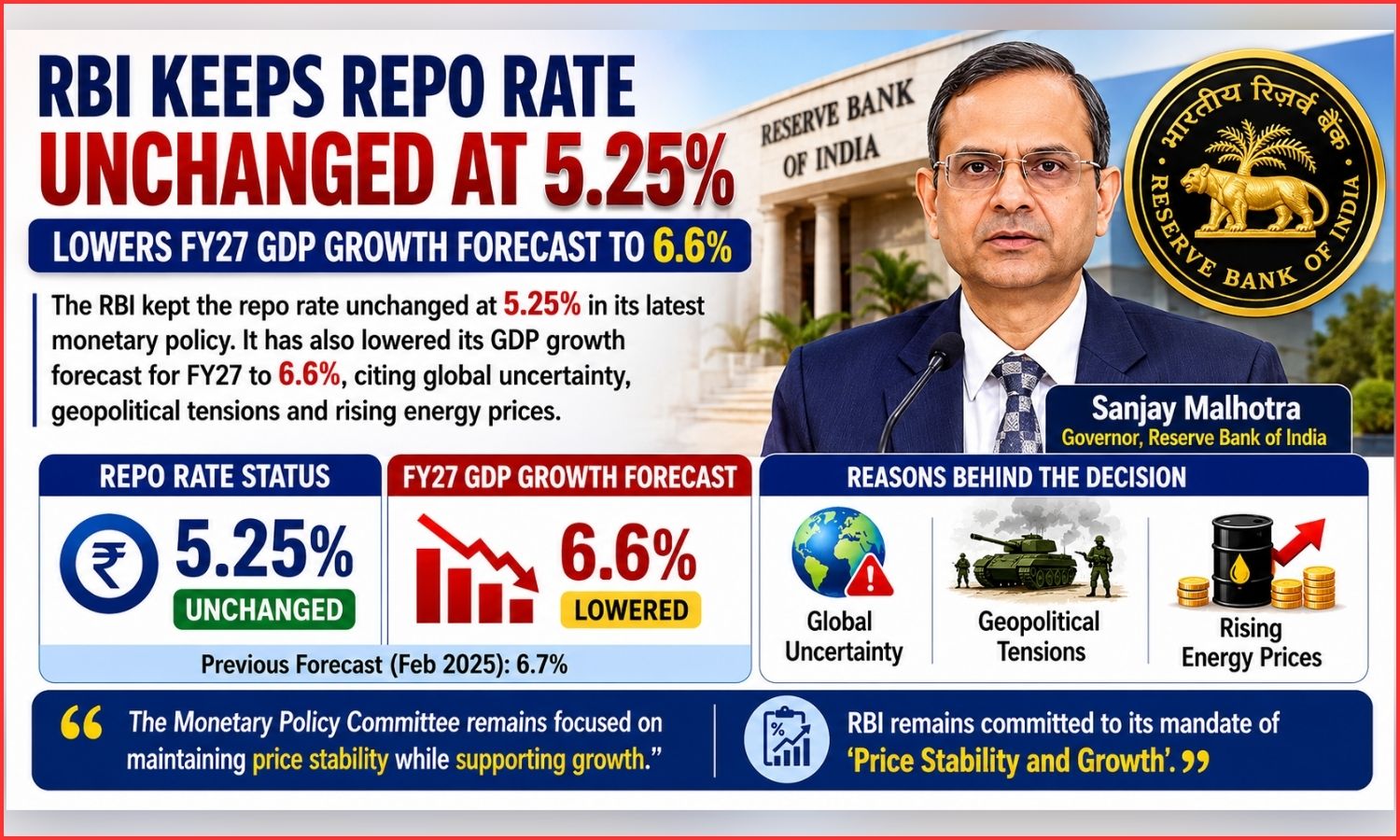
The Reserve Bank of India's Monetary Policy Committee has unanimously decided to maintain the repo rate at 5.25 per cent, following its second bi-monthly policy review for FY27 conducted between June 3 and June 5.
The central bank left its other key policy rates unchanged as well. The Standing Deposit Facility rate remains at 5 per cent, while the Marginal Standing Facility rate and bank rate continue at 5.5 per cent.
RBI Governor Sanjay Malhotra explained that the committee had carefully assessed the current macroeconomic and financial landscape before arriving at its decision. While acknowledging that the Indian economy has demonstrated resilience, he noted that certain sectors are experiencing emerging pressures.
The most significant shift in the RBI's stance comes through its revised growth forecast. The central bank has trimmed its real GDP growth projection for FY27 to 6.6 per cent, down from the earlier estimate of 6.9 per cent. This downward revision reflects concerns about global uncertainty, geopolitical tensions, supply chain disruptions, and elevated energy prices, the RBI indicated.
Despite these headwinds, Malhotra pointed out that services exports are expected to maintain their strength despite the challenging global environment. He also highlighted that government interventions have played a role in helping the economy absorb external shocks.
On the inflation front, the governor noted that consumer price inflation currently remains subdued. However, he warned that price pressures could intensify during the third quarter, potentially moving closer to the upper end of the RBI's tolerance band. Additional risks to inflation include the possibility of a below-average monsoon season and potential El Nino conditions.
The domestic economy continues to be supported by private consumption, with households maintaining steady discretionary spending patterns. Merchandise exports have also shown continued growth momentum despite ongoing geopolitical instability. However, Malhotra cautioned that rising input costs are becoming increasingly apparent across various economic sectors.
Compare options


