Nehru's Vision Laid Foundation for Modern India's Development, Says Minister
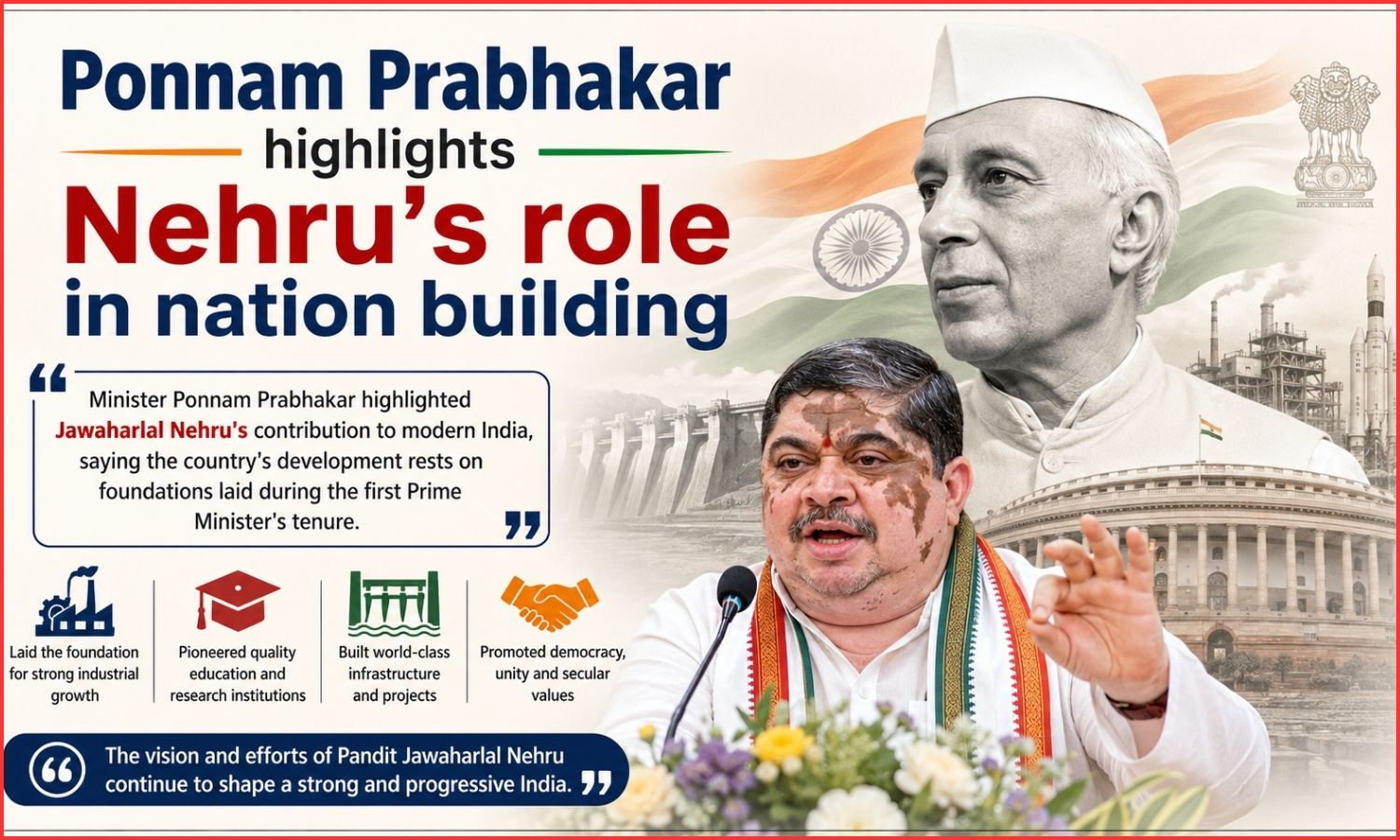
Hyderabad: Telangana's Transport and BC Welfare Minister Ponnam Prabhakar has underscored the enduring significance of Jawaharlal Nehru's contributions to India's development, characterizing the first Prime Minister as the architect of modern India's institutional and economic foundations.
Speaking on Nehru's legacy, the minister noted that the country's founding leader navigated India through a challenging post-Independence period marked by acute food scarcity and minimal industrial capacity. Despite these constraints, Prabhakar credited Nehru's foresight and long-term vision with charting a course toward sustained national development.
The minister highlighted the tangible outcomes of Nehru-era initiatives, pointing to educational institutions, healthcare infrastructure, and major development projects that emerged during his tenure. These establishments, according to Prabhakar, have become cornerstones of India's growth trajectory, with contemporary achievements rooted in policies and frameworks conceived during that foundational period.
Prabhakar further noted that subsequent administrations have built upon the groundwork established in those early years. He specifically referenced India's transformation in food production and export capacity as evidence of the effectiveness of Nehru's early developmental strategies. The expansion of industrial enterprises, public sector undertakings, and Navratna companies during this phase, he asserted, bolstered economic capacity and generated widespread employment.
Beyond economic dimensions, the minister emphasized Nehru's commitment to democratic values and institutional pluralism. Prabhakar stressed that Nehru recognized the importance of accommodating diverse viewpoints and maintaining robust parliamentary opposition, principles he characterized as essential to democratic governance and constitutional adherence.
In his assessment, Prabhakar contended that Nehru's sacrifices and institutional contributions to nation-building remain beyond reproach. While acknowledging the legitimacy of evaluating leaders' achievements, he cautioned against diminishing the legacies of figures whose endeavors proved instrumental in shaping the nation.
Compare options