Paytm's Disciplined Turnaround: From Survival to Sustainable Profitability
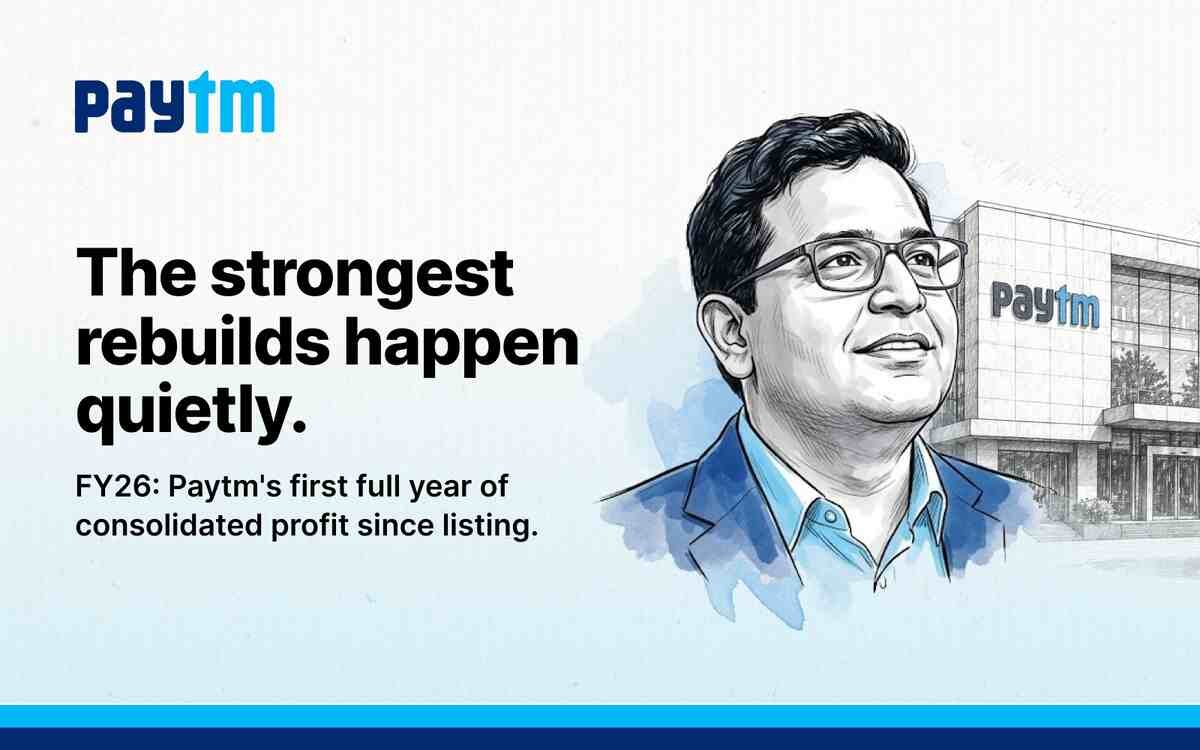
The financial community is reassessing Paytm. Following two years of intense market scrutiny and concerns about the company's viability, One 97 Communications—Paytm's parent entity—has delivered its first full-year consolidated profit since going public. This achievement has catalysed a notable reappraisal of the fintech company's prospects on Dalal Street.
The shift extends beyond the headline numbers. The conversation around Paytm has fundamentally transformed. Twelve months earlier, investors were preoccupied with stabilisation questions. Now, market participants are analysing payment processing margins, financial services expansion, wealth management potential, and the productivity gains from artificial intelligence deployment.
For the financial year ending March 2026, Paytm generated operational revenue of ₹8,437 crore, representing a 22% year-on-year increase. EBITDA reached ₹502 crore, compared to a ₹1,506 crore loss in the previous fiscal year—a swing of ₹2,008 crore. The company posted a net profit of ₹552 crore.
Vijay Shekhar Sharma's response to the challenging period was methodical rather than reactive. The company eschewed high-profile strategic overhauls in favour of systematic operational refinement. Marketing outlays contracted from ₹508 crore to ₹275 crore. Compensation expenses decreased to ₹2,765 crore from ₹3,288 crore. Miscellaneous operating costs fell to ₹1,418 crore from ₹1,695 crore.
This disciplined approach defines the contemporary Paytm narrative: expansion achieved through fiscal restraint.
Bank of America characterised the March quarter as an "operational leverage-led EBITDA beat," noting that profitability remained stable despite the withdrawal of PIDF incentives and the absence of UPI-related payments. Jefferies highlighted "healthy core growth" and attributed margin improvements to "operating synergies," while suggesting that emerging payment and financial products in lending and wealth management could sustain revenue growth exceeding 20% annually alongside EBITDA expansion for the subsequent three years.
The March quarter performance underscores market interest. Revenue climbed 18% year-on-year to ₹2,264 crore on a reported basis, or 26% on a comparable basis, despite losing PIDF support and receiving no UPI incentive disbursements. Paytm indicated it had already compensated for 30-40% of the PIDF reduction during the quarter.
This development carries strategic significance. The central investor concern was not whether Paytm could expand under favourable conditions, but rather whether it could navigate incentive reductions and regulatory pressures while sustaining operational momentum. The March results demonstrated that earnings growth is progressively decoupling from external subsidies and becoming increasingly reliant on operational execution.
JM Financial observed that underlying growth remained "materially stronger" on a comparable basis, fuelled by gross merchandise value expansion, structurally enhanced payment processing margins, and expanding financial services penetration. Motilal Oswal characterised progress as steady advancement toward "sustainable profitability," underpinned by operating leverage and resilient GMV development.
Mirae Asset labelled the quarter "resilient" and identified financial services as a "high-growth and high-margin engine," with AI-powered cross-selling opportunities providing substantial room for capital-efficient scaling.
While the Paytm Payments Bank situation persists in public discourse, market participants increasingly distinguish it from the core operating entity's performance. Paytm has asserted that the bank matter carries no financial or operational implications for the listed company. Analysts have similarly noted that commercial ties between the listed entity and the bank had been severed, with the investment written down. Against this backdrop, FY26 demonstrates the listed company advancing despite the disruption rather than awaiting its resolution.
The revenue composition has diversified considerably. Payments operations continue generating scale. Financial services distribution contributes higher-margin income streams. Wealth and commerce are materialising as emerging expansion vectors. Collectively, these segments provide Paytm multiple growth mechanisms beyond its foundational payments business.
This transformation is reflected in analytical language. Paytm is no longer characterised primarily as a turnaround play. It is increasingly evaluated as a platform enterprise where scale, distribution reach, and disciplined cost management can drive profitability.
Artificial intelligence represents the next frontier. During the earnings presentation, Sharma identified AI agents as a priority focus for the coming year, with applications spanning merchant and consumer services. The company has underscored AI-driven product development and operational efficiency as levers for prospective margin enhancement.
For Sharma, FY26 may become emblematic of the year discipline transformed into corporate strategy. Paytm's initial character was defined by category innovation—mobile payments, QR code deployment, and merchant devices. The emerging chapter centres on operational sophistication.
The FY26 narrative is unmistakable: Paytm's recovery resulted not from a singular transformative intervention but from systematic cost discipline, enhanced execution, operational leverage optimisation, and refined portfolio composition. While less headline-grabbing than a dramatic turnaround narrative, this methodical approach represents precisely the kind of reconstruction that markets historically reward.
Compare options