Maruti Suzuki Reaches 3 Million Vehicle Shipments via Rail, Advancing Sustainable Logistics
Maruti Suzuki India Limited has announced a landmark achievement in its environmental logistics strategy, having cumulatively shipped more than 3 million vehicles via railway networks. The announcement underscores the company's dedication to reducing its carbon footprint through sustainable transportation methods.
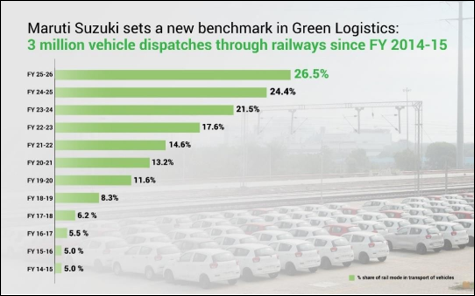
The automotive manufacturer has substantially expanded its reliance on rail transport over the past ten years. In FY 2014-15, railways accounted for merely 5% of the company's outbound logistics operations. By FY 2025-26, this proportion has grown to 26.5%, reflecting a strategic shift toward green transportation. Notably, the acceleration from the 2 million to 3 million milestone was accomplished in just 21 months, representing the quickest progression of any million-unit threshold in the company's rail logistics history.
Hisashi Takeuchi, Managing Director and Chief Executive Officer of Maruti Suzuki, highlighted the significance of the achievement. "Reaching 3 million cumulative vehicle dispatches through railways represents an important chapter in our sustainability narrative," he stated. "Since 2014, our railway-based dispatch volumes have expanded ninefold, now representing more than a quarter of all vehicle movements. The company has channeled over INR 13,720 million into dedicated green logistics infrastructure development."
This investment encompasses multiple strategic initiatives. The company has constructed in-plant railway sidings at its Hansalpur and Manesar production facilities, established rail yards at major logistics distribution centers, purchased specialized automotive transport rakes, and funded various supporting infrastructure enhancements.
Takeuchi acknowledged the role of government policy in enabling this transition. "We are grateful to the Government of India for the PM GatiShakti National Master Plan, which has established a robust framework for coordinated, multimodal logistics solutions. This framework has been instrumental in facilitating the industry's movement toward rail-based, efficient, and environmentally responsible freight systems," he noted.
Looking ahead, Maruti Suzuki has set an ambitious target to increase the share of railway-based vehicle dispatches to 35% by FY2030-31. The company plans to construct an in-plant railway siding at its upcoming Kharkhoda manufacturing facility to support this expansion. These measures are expected to further diminish carbon emissions, reduce fuel usage, and alleviate congestion on road networks.
Compare options