Astronomy: Century's Most Prolonged Total Solar Eclipse Set for August 2027
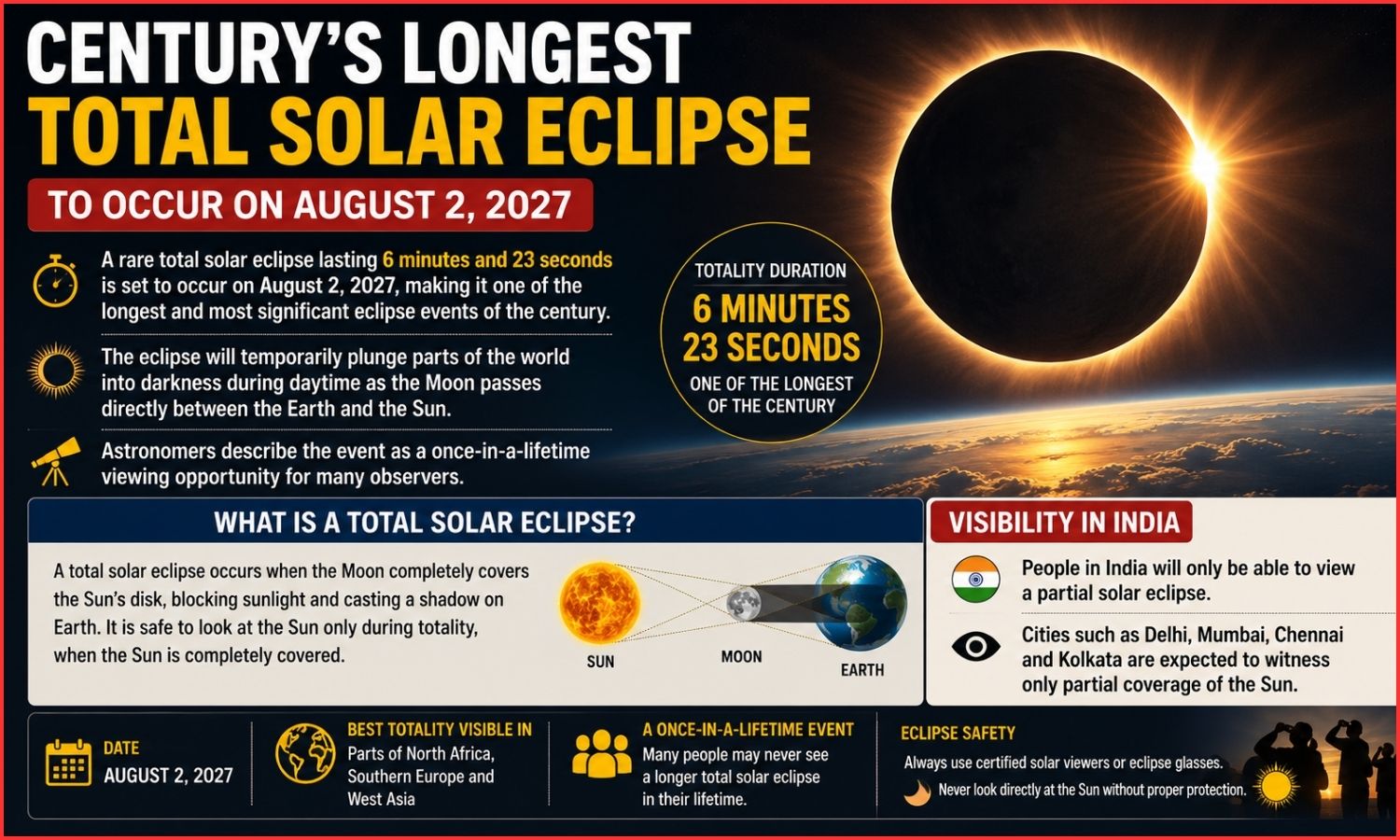
A spectacular total solar eclipse will grace the skies on August 2, 2027, delivering what astronomers regard as a singular viewing phenomenon. The celestial event will persist for 6 minutes and 23 seconds, positioning it among the century's most extended eclipses.
During this occurrence, the Moon will situate itself directly in the line between Earth and the Sun, casting vast regions of the world into temporary darkness in the middle of the day.
The path of totality will traverse portions of North Africa, the Middle East, and southern Europe. Egypt's Luxor stands out as an exceptional vantage point, where observers will experience the maximum duration of totality.
Residents across Spain, Morocco, Algeria, Tunisia, Libya, Sudan, Saudi Arabia, and Yemen will have the opportunity to view the eclipse.
For Indian skywatchers, the experience will be limited. Delhi, Mumbai, Chennai, and Kolkata are among the cities expected to witness only a partial solar eclipse, with the Sun partially obscured rather than completely blocked.
A separate eclipse event is also on the astronomical calendar. An annular solar eclipse will occur on August 12, 2026. In this configuration, the Moon will obscure the Sun's central region while allowing a luminous band to remain visible around the lunar silhouette—a phenomenon astronomers term the "Ring of Fire."
This 2026 eclipse will commence at 9:04 pm IST and conclude at 4:25 am IST according to calculations. However, the timing places it beyond the viewing window for Indian observers, as it will unfold during nighttime hours. Instead, those in Greenland, Iceland, Spain, and Arctic regions will be positioned to observe the spectacle.
Compare options


