India's Evolving Travel Landscape: How Hospitality Platforms Are Adapting to Work, Transit, and Experience
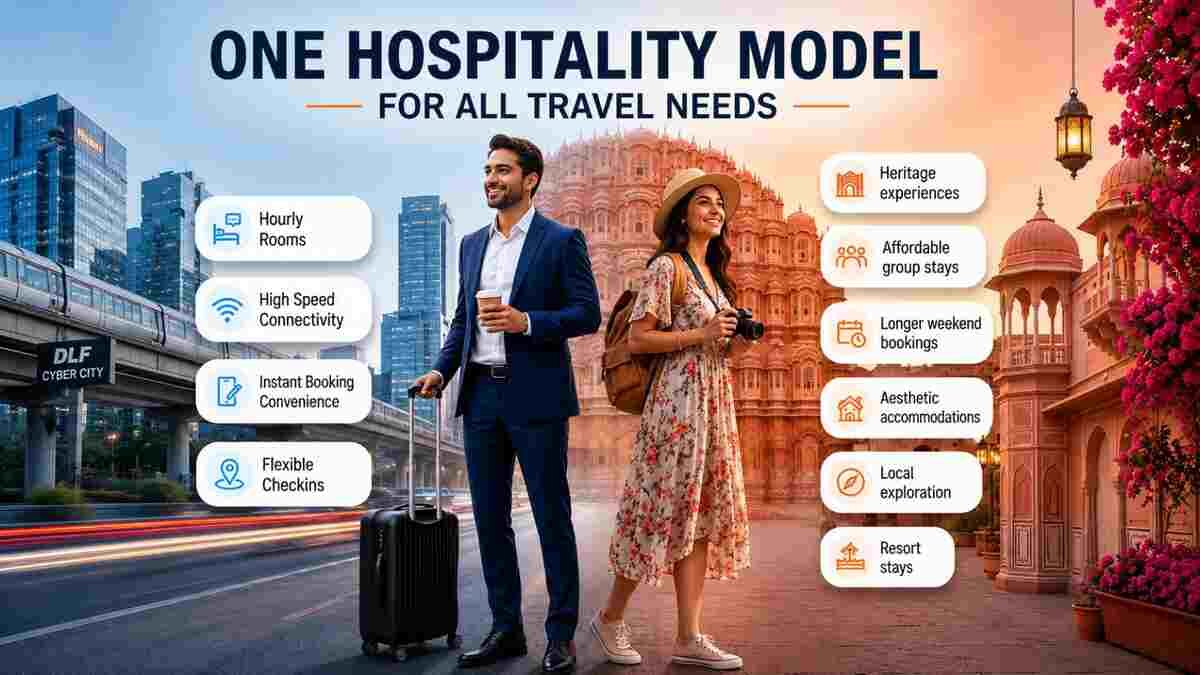
India's travel economy is undergoing a fundamental transformation. Rather than catering to a single traveler archetype, the country is experiencing the emergence of what observers describe as a new travel triangle encompassing Work, Transit, and Experience. Contemporary travelers move across India for varied reasons—professional meetings, business mobility, flexible arrangements, brief getaways, and lifestyle-oriented journeys.
The Changing Nature of Travel Motivations
The landscape differs sharply across geographies. In metropolitan centers like Gurugram and Mumbai, travel is intricately linked to business operations and corporate demands. Professionals arrive for meetings, management consultants commute between offices, entrepreneurs navigate multiple cities, and workers embracing hybrid arrangements increasingly require accommodations that accommodate unpredictable schedules.
Conversely, destinations such as Jaipur and Goa draw travelers seeking cultural immersion, leisure pursuits, discovery, and authentic engagement. For these visitors, accommodation is not merely a functional space but rather a curated experience—a weekend escape, a celebration venue, or a reprieve from metropolitan life.
Remarkably, hospitality platforms like Bag2Bag Hotels & Homes are managing to serve both markets simultaneously, adapting their operations to accommodate these divergent travel patterns without abandoning their foundational framework.
Breaking Away from Traditional Hospitality Models
Conventional hospitality infrastructure has long operated under standardized assumptions: single-night bookings, predetermined check-in procedures, uniform room specifications, and uniform service delivery across locations.
Today's traveler operates differently. A professional in Gurugram may require a room for just several hours between consecutive meetings, flexible arrival times, proximity to business districts, dependable internet connectivity, and streamlined booking processes. A leisure traveler in Jaipur, by contrast, prioritizes heritage encounters, economical group accommodations, extended weekend stays, aesthetically distinctive spaces, opportunities for local engagement, and resort-style facilities.
The fundamental purpose of travel has evolved, necessitating corresponding shifts in hospitality service delivery.
Gurugram: Business and Mobility Redefined
Gurugram epitomizes India's contemporary work environment. The city hosts a dense ecosystem of international corporations, technology startups, independent consultants, distributed teams, and frequent business travelers, all operating within a framework prioritizing speed and adaptability. Travel in this context is frequently pragmatic and time-constrained.
Arriving executives may land on early flights, navigate consecutive meetings, or extend their stays based on shifting work requirements. Increasingly, professionals are also incorporating personal relaxation into work trips, generating demand for more versatile accommodation arrangements.
"Transit hospitality" is emerging as a significant market segment. Hotels are evolving beyond overnight accommodation to function as temporary offices, rest facilities, conference venues, and flexible urban amenities.
Bag2Bag's operational structure naturally accommodates this behavioral shift through instantaneous bookings, abbreviated stays, varied usage scenarios, mobile-centric services, and positioning across professional zones. In business-intensive areas like Gurugram, convenience frequently supersedes luxury considerations. Professionals prioritize seamless transactions that integrate smoothly into demanding schedules.
Jaipur: The Experience-Centered Traveler
Jaipur embodies the contrasting dimension of India's contemporary travel evolution. Where Gurugram emphasizes efficiency and urgency, Jaipur attracts travelers motivated by heritage, architectural beauty, regional gastronomy, festivities, and unhurried exploration.
Yet visitor expectations are transforming here as well. Contemporary Jaipur travelers encompass more than conventional tourists. The destination increasingly draws metropolitan weekend visitors, content creators, location-independent professionals, attendees of destination celebrations, young couples, and heritage enthusiasts.
These visitors expect hospitality to be digitally seamless, adaptable, and economically accessible while maintaining cultural authenticity and local character.
Bag2Bag's platform flexibility proves valuable in this context. Without restructuring its fundamental operations, the platform accommodates entirely different travel objectives: extended leisure stays, thoughtfully selected accommodations, options suitable for groups, budget-conscious adaptability, and frictionless digital reservations.
In Jaipur's context, the accommodation itself becomes integral to the overall experience.
A Unified Infrastructure for Diverse Needs
The distinctive element of this transformation is that Bag2Bag is not constructing separate operations for different cities. Rather, it is developing hospitality infrastructure capable of responding to varying travel behaviors across the nation.
Corporate centers demand responsiveness and expedited service. Culturally significant destinations require meaningful engagement and quality comfort. Transportation corridors necessitate convenient access. Emerging urban centers require cost-effective solutions.
The hospitality sector's future may not rest with inflexible accommodation formats, but rather with platforms capable of responding dynamically to what travelers actually need. Bag2Bag's positioning reflects this fundamental industry transition.
The Rise of Purpose-Driven Accommodation
Historically, the hospitality sector has segmented travelers into basic categories: business travelers, leisure visitors, and luxury clientele.
Contemporary travel patterns are considerably more complex and fluid. Individual travelers might work remotely in Gurugram during weekdays, travel to Jaipur for a weekend, arrange brief stays during connections, unexpectedly prolong journeys, or combine professional obligations with personal enjoyment.
This has generated market demand for what industry observers term "intent-led hospitality"—accommodation that aligns with the specific purpose of each journey rather than imposing predetermined structures on travelers.
Throughout India, flexibility has become a paramount expectation in accommodation choices.
As travel patterns continue evolving, hospitality platforms that comprehend regional city characteristics while preserving operational efficiency may establish the trajectory for the sector's subsequent development.
A New Era for Indian Travel
India's travel future transcends mere destination selection. It encompasses movement across professional commitments, transit requirements, and experiential pursuits. Although Gurugram and Jaipur represent distinct facets of contemporary India, collectively they demonstrate a significant consumer transformation: travel is becoming progressively dynamic, increasingly aligned with specific intentions, and more individually customized.
Bag2Bag's expanding prominence derives from recognizing this transformation, constructing a hospitality platform sufficiently flexible to simultaneously address the operational demands of corporate India and the cultural richness of experiential India.
Compare options