ICC World Technology Convention 2026 Launches with Focus on India's Tech and Manufacturing Growth
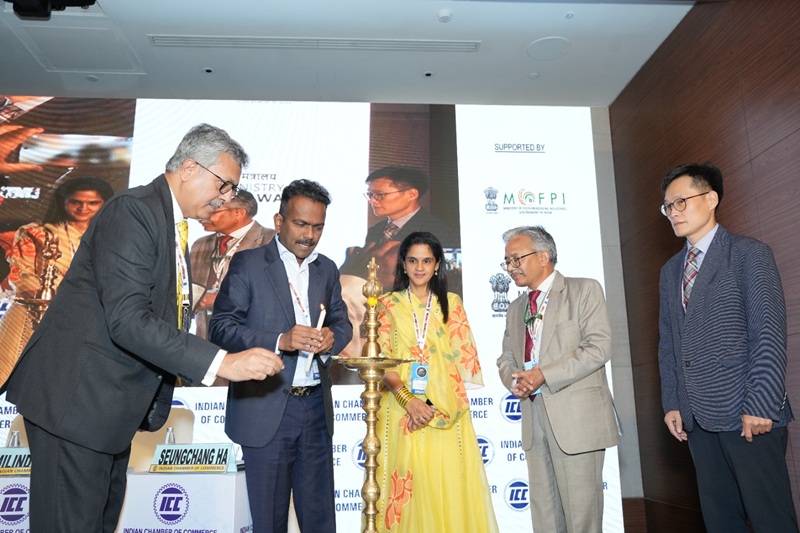
Mumbai — The Indian Chamber of Commerce officially opened the ICC World Technology Convention 2026 at the Jio World Convention Centre, assembling policymakers, business executives, researchers, technology firms, and international participants to examine India's expanding role in global technology and innovation.
During the opening proceedings, two significant partnerships were formalized: a bilateral memorandum of understanding between ICC and South Korea's Chungcheongnam-do Economic Promotion Agency (CEPA), and another between ICC and IIT Bombay. The CEPA agreement aims to deepen commercial ties and bilateral trade between India and South Korea, while the IIT Bombay partnership seeks to bridge the gap between academic research and industry through joint initiatives in innovation, technology advancement, and business creation.
Deepak Bagla, Mission Director of the Atal Innovation Mission under NITI Aayog, highlighted a fundamental shift in India's innovation landscape. "India's innovation movement has shifted decisively from the top down, and is now being shaped by students in government schools, rural classrooms, and small-town tinkering labs, building solutions to problems they live with every day," he explained. He emphasized that the growing number of startups masks a more significant development—the democratization of entrepreneurial thinking across previously excluded populations. "The next globally consequential breakthrough may well come from a district-level classroom, and that possibility calls for a serious, coordinated effort from industry, academia, government, and capital to give every young builder a real chance to experiment, fail, and scale."
IIT Bombay's Deputy Director, Professor Milind Atrey, stressed the necessity of translating academic research into practical applications. "Research in India cannot remain confined to laboratories. Academic institutions today have to work more closely with industry to convert research into products, startups and technologies that solve real problems," he noted. He underscored his institution's commitment to strengthening ties between academia and industry through translational research and entrepreneurship-focused initiatives.
Maharashtra's Industries Department emphasized the state's competitive positioning. Principal Secretary Dr. P. Anbalagan stated that Maharashtra is cultivating an environment conducive to manufacturing, technology investment, and long-term growth. "The state is seeing strong momentum across sectors such as electronics, EVs, aerospace, semiconductors, GCCs and data centres, backed by infrastructure expansion, policy reforms and faster approvals," he said.
The India-South Korea business connection received attention from Seungchang Ha, Chief Representative of CEPA India, who noted rising enthusiasm for collaboration. "There is growing interest among Korean and Indian companies to work together across manufacturing, automobiles, electronics and startups. The partnership between CEPA India and ICC will help companies from both countries connect more directly and explore long-term business opportunities."
Dr. Sasmit Patra, a Rajya Sabha member from Odisha, addressed mining sector transformation. He cautioned that mining cannot rely solely on extraction metrics and must prioritize environmental stewardship and community welfare. "The sector will increasingly be judged on transparency, environmental accountability and community engagement," he observed. He identified emerging technologies such as AI-driven compliance systems, satellite monitoring, digital mine twins, and predictive analytics as tools to advance responsible mining practices under the Mining 5.0 framework.
India's defence sector capabilities were discussed by Mangal Lal Chand, Distinguished Scientist and Director General of Technology Management at DRDO. He outlined the shift toward collaborative defence innovation involving industry, academia, startups, and research bodies. "Deep-tech areas such as drones, semiconductors and advanced electronics will play a major role in the future of indigenous defence manufacturing," he stated, emphasizing the importance of developing technologies domestically and creating intellectual property.
ICC Director General Dr. Rajeev Singh characterized technology as a catalyst for cross-sector collaboration. "Technology is changing every sector and creating new opportunities for collaboration between industry, academia and governments," he said.
The inaugural session also featured remarks from Major Vineet Kumar, Founder & Global President of Cyber Peace; Anil Razdan, Former Secretary of the Ministry of Power; and Dr. Kalirajan S, Managing Director of EDF Nuclear Project India Pvt Ltd, alongside representatives from energy, mining, defence, fintech, healthcare, cybersecurity, logistics, and education sectors.
The convention's first day centered on technology's application across key industries, manufacturing, and infrastructure, organized under the theme "Technology for Make in India." Concurrent sessions explored Energy & Greentech, Mining 5.0, Defence, Aero & Space Technology, Agritech & Foodtech, MedTech, FinTech, Cyber Risk, and Education Technology, complemented by state-specific discussions and business-to-business meetings. Participants deliberated on deep-tech implementation, AI-driven industrial modernization, cybersecurity frameworks, domestic manufacturing capabilities, environmental sustainability, digital infrastructure development, and strengthened academia-industry partnerships. The day concluded with the ICC Technology Excellence Awards ceremony, honoring innovative and technology-driven achievements across multiple industries.
Compare options