Chandigarh Startup Transforms Disaster-Damaged Goods Into Industrial Raw Materials
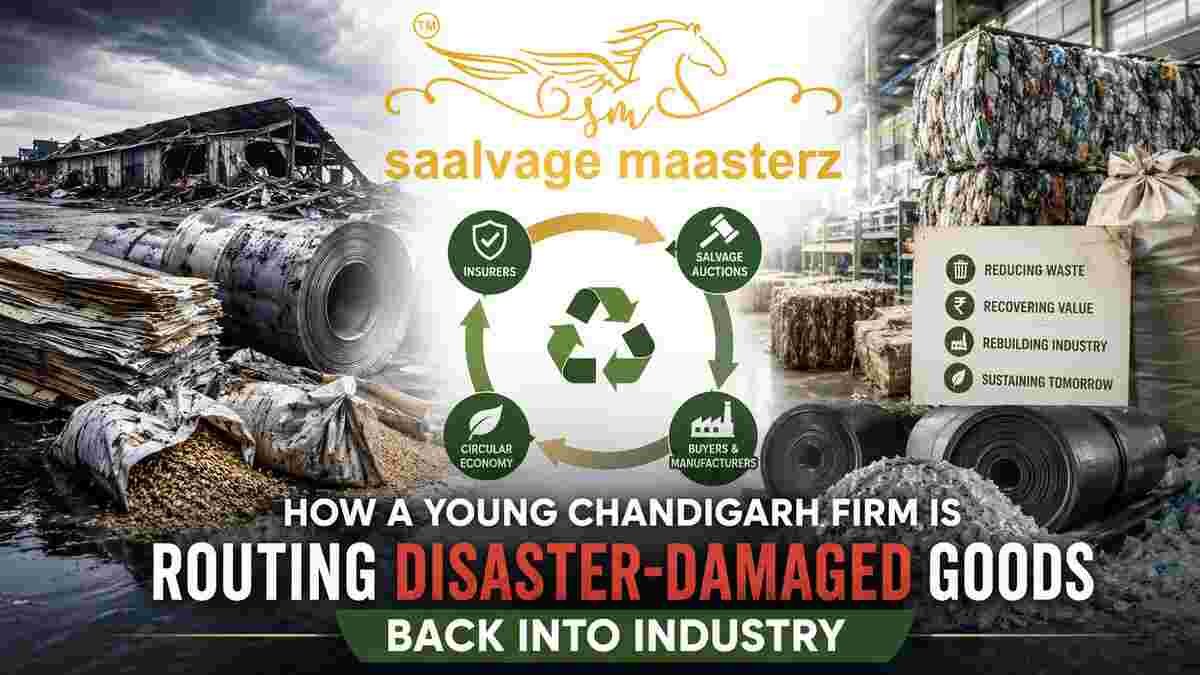
Annually, natural disasters and accidents—fires, floods, cyclones, and collisions—leave behind damaged merchandise valued at crores of rupees. Factory fires warp metal coils beyond recognition. Floodwaters destroy paper stocks entirely. A blaze at a grain facility can ruin tonnes of produce. Historically, such damaged inventory has been discarded as waste or deposited in landfills without further consideration.
Enter Saalvage Maasterz, a salvage management enterprise based in Chandigarh that is redefining how India handles post-disaster goods. Rather than processing materials itself, the firm operates as a bridge—identifying damaged goods from insurance auctions and connecting them with manufacturers, recyclers, and traders capable of reusing them productively.
India's transition toward a circular economy is accelerating. Union Environment Minister Shri Bhupender Yadav has projected that the nation's circular economy sector could expand to a market value of $2 trillion and generate approximately 10 million jobs by 2050, marking a departure from the conventional "take-make-dispose" consumption pattern toward models emphasizing recovery and reuse. The country currently produces roughly 62 million tonnes of waste annually, with plastic and other recoverable materials representing significant growth areas.
Within this transformation lies an often-overlooked yet commercially significant dimension: insurance salvage management. Following an insured loss, insurers settle claims and subsequently auction the damaged merchandise. Much of this material retains substantial value—bent metal can be remelted, waterlogged paper can be repulped, and recovered grain, plastics, and films can re-enter their original manufacturing chains. The persistent challenge has been establishing effective connections between salvaged inventory and the businesses positioned to utilize it.
Saalvage Maasterz addresses precisely this disconnect. Registered and accredited with major insurance providers throughout India, the firm participates in salvage auctions, acquires damaged materials, and redistributes them—metals, paper, plastics, tyres, films, grains, and related commodities—to end-buyers at economical rates. The company functions as an intermediary exclusively, handling sourcing and redistribution without engaging in material processing or recycling operations.
Since commencing operations in 2024, the enterprise has demonstrated considerable traction. The firm has finalized 98 salvage transactions with an established network of 83 buyers and has successfully returned more than 1,600 tonnes of recovered material into industrial supply chains, alongside additional inventory measured by unit count and area. The organization is managed by professionals possessing substantial prior experience within the salvage sector.
The commercial rationale for salvage reuse is compelling. Recovered materials typically cost considerably less than virgin alternatives, enabling manufacturers—particularly resource-constrained MSMEs—to reduce raw material expenses. Simultaneously, redirecting usable goods from disposal sites diminishes environmental strain during a period when India's landfill infrastructure faces mounting pressure.
The firm's operational philosophy rests on three cornerstones: reliability, resourcefulness, and pragmatism. Each salvage transaction follows a comprehensive framework encompassing case evaluation, detailed documentation, physical verification facilitation, and logistical coordination post-transaction.
As regulatory requirements including Extended Producer Responsibility frameworks grow more stringent and industrial demand for recovered materials expands across packaging, construction, and manufacturing sectors, intermediary organizations capable of efficiently channeling salvage back into production networks are positioned to assume increasingly vital roles within India's evolving circular economy landscape.
Saalvage Maasterz, headquartered in Chandigarh and ISO 9001:2015 certified, was established in 2024 and maintains operations nationwide. The organization specializes in procuring salvage inventory from insurance auctions and reallocating it to traders, recyclers, and manufacturers, functioning as an intermediary rather than as a processing facility.
Compare options