Forum Calls on Telangana to Shelve New Irrigation Schemes, Focus on Existing Projects
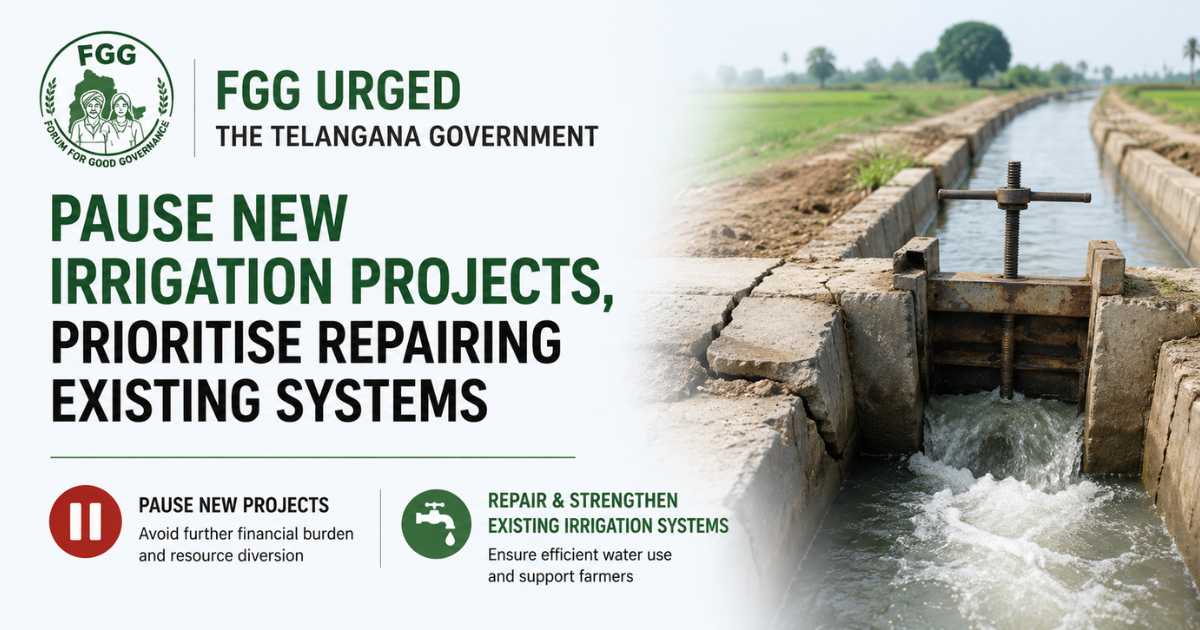
Hyderabad — The Forum for Good Governance has appealed to the Telangana government to put new irrigation projects on hold and redirect attention towards finishing and maintaining schemes already in place.
In correspondence to Chief Minister A. Revanth Reddy, Forum president M. Padmanabha Reddy highlighted that major irrigation undertakings across the globe frequently carry substantial financial outlays, implementation delays, ecological impacts, population displacement, and graft-related issues.
The organisation pointed out that abundant irrigation water supply coupled with complimentary power has fuelled intensive paddy farming, crowding out cultivation of pulses, oilseeds, cotton, and horticultural products. This imbalance has created market difficulties stemming from paddy oversupply, the Forum noted.
To address this, the Forum recommended that the Agriculture Department promote a shift toward diverse crops through incentive schemes and assured procurement rates for other agricultural products.
Examining Telangana's irrigation landscape, the Forum observed that major projects — the Kaleshwaram Lift Irrigation Project, Palamuru-Rangareddy Lift Irrigation Scheme, and Srisailam Left Bank Canal — have consumed lakhs of crores of rupees over the preceding 12 years without delivering the anticipated results.
The Forum has particularly questioned the viability of the proposed Tummidi Hatti undertaking on the Pranahita River, contending that the state should consolidate current infrastructure rather than embark on another large-scale venture. The earlier Pranahita-Chevella initiative was shelved, and approximately Rs. 1 lakh crore had been invested in the Kaleshwaram project by end-2023, according to the organisation.
Restoring and rehabilitating the Kaleshwaram project should rank as the state's foremost priority rather than launching additional expansive irrigation works, the Forum stressed. The organisation emphasised the importance of deliberate resource planning and judicious water management practices to circumvent mounting financial strain and operational complications.
Compare options