SSN Engineering Students Create Roof-Exit Safety System for Submerged Vehicles
Rising water levels in urban India have made vehicle submersion incidents increasingly common, particularly in flooded roadways and underpasses. When cars become trapped in such conditions, occupants face a life-threatening challenge: conventional doors become impossible to open due to external water pressure, leaving passengers with minimal time to find an escape route.
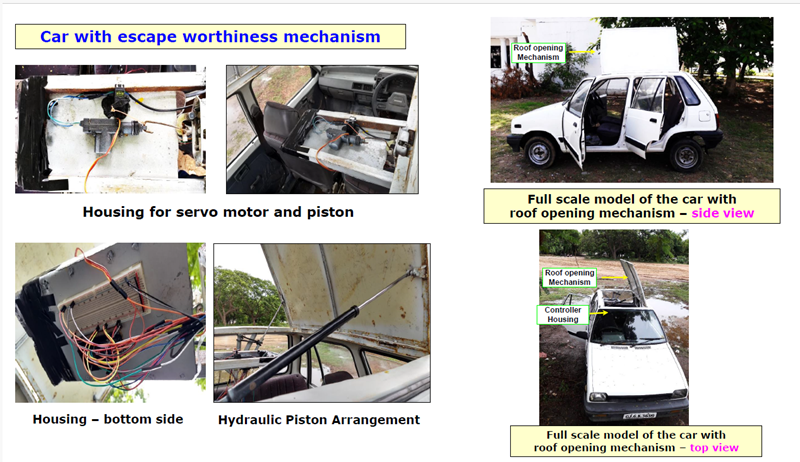
A team of researchers at SSN College of Engineering in Chennai and Mumbai has responded to this hazard by developing what they call the 'Improved Escape Worthiness of Car Occupants Under Drowning Environment'—a pneumatically controlled system that automatically opens a vehicle's roof when submersion is detected.
The project brings together Associate Professor Dr S. Suresh Kumar from the Department of Mechanical Engineering with student researchers B. Vishal and Neil Ashwin Raj. Their work exemplifies SSN's commitment to student-centered, practical engineering solutions addressing real-world challenges.
The core problem the system tackles is straightforward but severe. During submersion events—whether from flooding, accidents near water bodies, or extreme weather—passengers face a narrow window for escape. As water rises and pressure differentials increase, door mechanisms fail, leaving occupants trapped. Existing vehicle designs provide few alternatives in such emergencies.
The SSN innovation operates through sensor detection combined with a pneumatic activation mechanism. When submersion conditions are identified, the system triggers the roof to open at an early stage, creating a larger and more accessible exit point than conventional door openings. The design benefits all occupants, including rear passengers who typically have limited escape options.
A key advantage of this approach lies in its mechanical reliability. Rather than relying on electrical systems that may fail when submerged, or explosive mechanisms that pose additional risks, the hybrid control design prioritizes early activation and consistent performance under extreme conditions.
Beyond submersion scenarios, the system offers potential utility in other emergencies. Vehicles with jammed doors due to collision damage or fire could also benefit from the roof-exit capability, providing an additional rescue pathway for trapped occupants.
The prototype has undergone rigorous testing protocols. Engineers conducted Computational Fluid Dynamics simulations and real-time evaluations on a modified vehicle across multiple failure scenarios: flat sinking, side tilting, and nose-diving positions. Results demonstrated reliable operation across these varied conditions.
Dr S. Suresh Kumar remarked on the urgency of the challenge: "When vehicles are drowning, the available time is critically short and standard escape methods frequently become unavailable. Our focus is on expanding the ways people can exit safely under these extreme circumstances, ultimately strengthening passenger protection when such emergencies occur."
The research team is now pursuing partnerships with automotive manufacturers and safety organizations to evaluate how this technology might be incorporated into production vehicles. Such integration would be particularly valuable in flood-prone regions where water-related vehicle emergencies remain a persistent threat to public safety.
Compare options