Over 300 Women Earn Secondary Certification Through Educate Girls' Second-Chance Program in Rajasthan
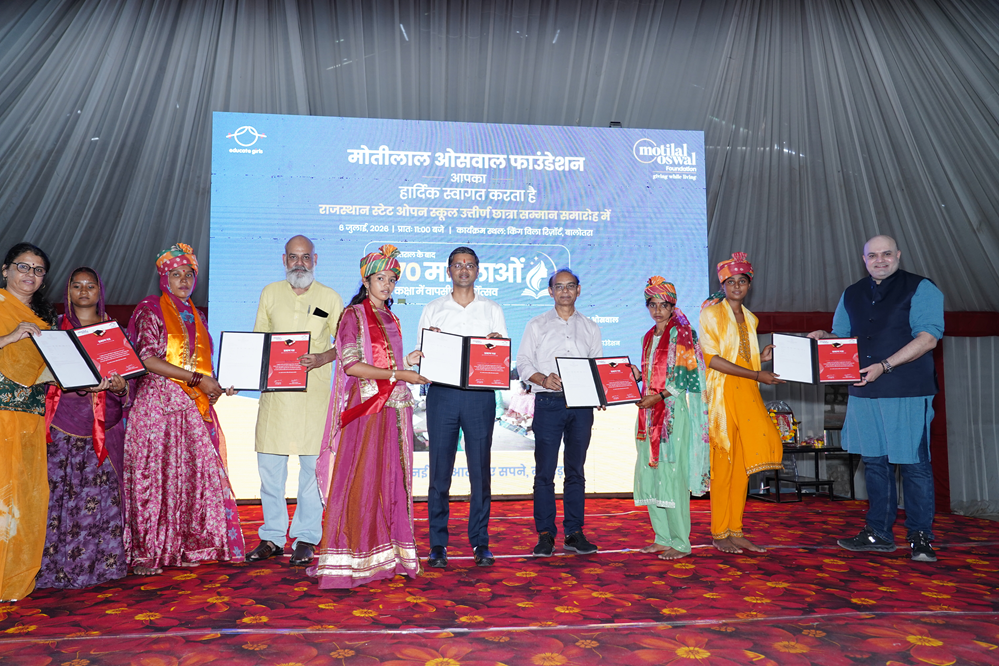
In Balotra, Rajasthan, the non-profit organization Educate Girls held a felicitation ceremony to mark the academic accomplishments of more than 300 learners who successfully completed their Grade 10 Rajasthan State Open School examinations. The Pragati program, which offers second-chance education, brought together participants, government officials, community leaders, and family members to recognize women and girls who returned to their studies after leaving school due to personal, financial, or family-related challenges.
Sushil Kumar Yadav, IAS and District Collector of Balotra, served as chief guest at the event. He commended the educational initiatives underway in the district and stressed the need for sustained support spanning early childhood education through open schooling, digital literacy, higher secondary studies, and vocational training. He urged the graduates and their families to maintain their educational aspirations while pledging backing for Educate Girls' work in expanding access to schooling for girls and women.
The examination results demonstrate significant program effectiveness. Of the enrolled learners, 90 percent sat for the exams. Among test-takers, 109 successfully completed all subjects on their first sitting and obtained their secondary school certificates, while 161 partially passed and remain on track to finish their certification in subsequent examination sessions. An additional 25 learners achieved scores above 60 percent, underscoring the caliber of academic performance within the second-chance initiative.
The ceremony recognized the progress of all participants. Those who achieved full certification received special honors, while those with partial results were encouraged to persist in their educational pursuits. Dimple, identified as the district's top-performing learner, was specially acknowledged alongside her parents. Her achievement and those of her peers exemplified the determination displayed by girls and women who chose to resume education despite facing considerable obstacles.
Safeena Husain, founder of Educate Girls, highlighted the transformative potential of education. "Education has the power to transform individual lives and entire communities," she remarked. "For many women, returning to education is an opportunity to reclaim aspirations that were once put on hold and create new possibilities for themselves and their families. The graduation of these women is a powerful reminder that it is never too late to learn, and that when women are given a second chance at education, the impact is felt across generations."
Motilal Oswal, founder of the Motilal Oswal Foundation, extended congratulations to the graduates, their families, community members, and Educate Girls. He indicated the Foundation's continued dedication to broadening educational prospects for girls and women in Balotra and outlined plans to scale the Balotra District Education Transformation Program through collaboration with local partners.
Vikram Singh Solanki, Director of Operations at Educate Girls, spoke to the organization's core objective of guaranteeing access to quality education for every girl. He congratulated the learners and encouraged them to view their graduation as a gateway to fresh opportunities, urging them to pursue continued learning throughout their lives.
The Pragati program has successfully reconnected more than 40,000 adolescent girls and young women across Rajasthan with educational pathways, fostering continued learning, economic independence, and improved employment prospects. The organization intends to enroll an additional 15,000 learners across the state within the next twelve months.
The gathering included graduates, Preraks (volunteer mentors), officials, organizational partners, community members, staff, and volunteers. The event underscored the academic achievements, bravery, and resolve of adolescent girls and women who refused to allow their circumstances to dictate their prospects. Their success illustrates the potential of second-chance education to establish avenues toward dignity, empowerment, and meaningful social transformation.
Compare options