Telangana's Digital Agriculture Push Faces Regional Divide, Threatening Equitable Growth
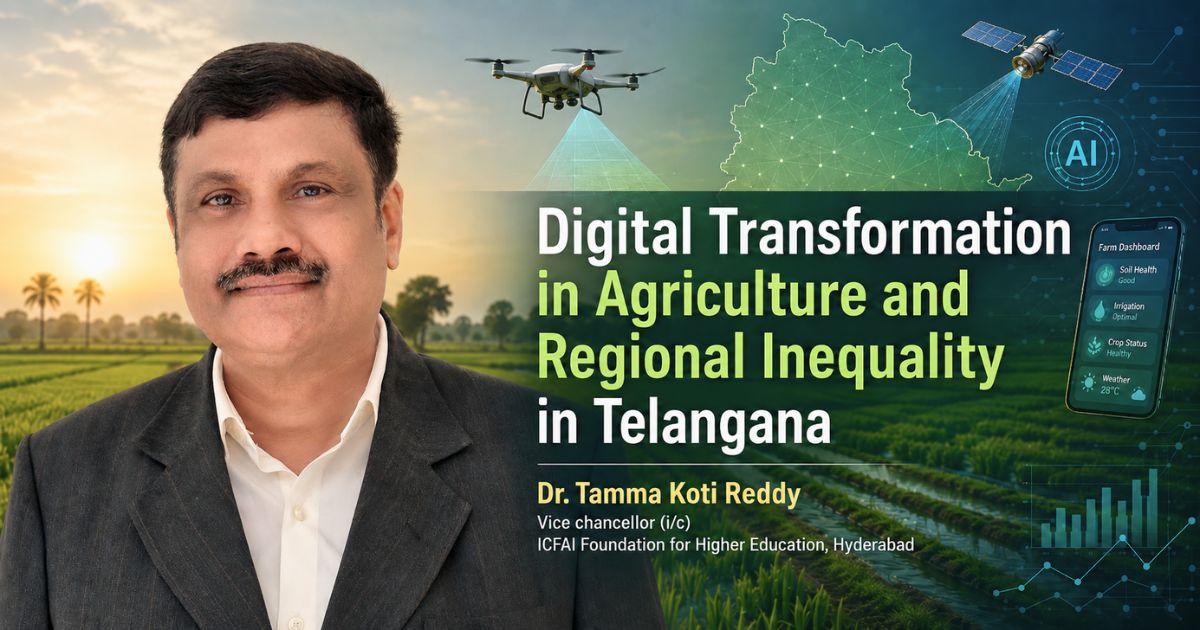
Hyderabad: Since its formation in 2014, Telangana has prioritized agricultural development through substantial infrastructure expansion and farmer-support initiatives. The state's investment in lift and large-scale irrigation schemes has substantially enlarged irrigable land, transforming the agricultural sector and positioning Telangana among India's leading rice-producing states. Government programs such as Rythu Bandhu and Rythu Bima, combined with round-the-clock free electricity for farming, have contributed to increased output across the state.
However, persistent structural challenges in crop diversification, resource management, and long-term sustainability continue to constrain the sector. To address these limitations, the state government has rolled out a suite of technology-enabled agricultural programs, including farmer-focused mobile applications, digital land record systems, online fertilizer procurement platforms, smart irrigation technologies, digital market linkages, and AI-powered crop guidance services.
The state's agricultural landscape comprises 70.60 lakh operational holdings, with small and marginal farmers representing approximately 91.4 percent of this total. Digital agriculture initiatives are designed to help this segment reduce farming expenses, boost yields, and gain better access to markets and government services. The government is also planning an extensive scientific land survey spanning 373 villages across all 25 districts, employing drone mapping and rover-based surveying systems to establish accurate digital land records.
Digital Agriculture as a National Priority
Across India, digital agriculture has emerged as a transformative force, enhancing productivity, market connectivity, and resource optimization. The central government has championed the adoption of technologies including artificial intelligence, mobile platforms, drone surveying, satellite imaging, automated irrigation systems, and digitized land documentation. Several states—Andhra Pradesh, Karnataka, Maharashtra, Punjab, Haryana, and Telangana—have pioneered creative digital solutions for farmers.
National programs such as e-NAM, PM-KISAN, Soil Health Cards, and the Digital Agriculture Mission have strengthened digitization efforts in rural regions. These initiatives have increased transparency, improved access to information and subsidies, reduced intermediaries, and promoted efficient and sustainable farming practices.
Uneven Digital Adoption Across Districts
Despite these advances, digital agriculture adoption in Telangana exhibits significant geographic disparities. Districts with strong irrigation infrastructure, including Karimnagar, Peddapalli, Nizamabad, Siddipet, Sangareddy, Medchal-Malkajgiri, and Rangareddy, have emerged as digital agriculture leaders. These regions benefit from reliable water supplies, commercial farming operations, robust internet infrastructure, higher farm incomes, well-organized farmer-producer organizations, and connections to agri-tech enterprises and market chains. Farmers in these areas increasingly utilize digital advisory services, automated input management systems, precision farming techniques, and market-access platforms.
A second tier of districts—Nalgonda, Jangaon, Warangal, Khammam, Mahabubnagar, Suryapet, and Kamareddy—are transitioning toward digitalization at a measured pace. While awareness of digital farming practices is growing, these areas contend with inadequate internet availability, limited institutional engagement, and restricted technology access for smallholder farmers. Digital adoption remains sporadic and inconsistent.
Tribal, forest-dependent, and chronically drought-affected districts including Adilabad, Komaram Bheem Asifabad, Mulugu, Jayashankar Bhupalpally, Nagarkurnool, Wanaparthy, Narayanpet, and Mahabubabad remain significantly behind in the digital transition. These regions suffer from poor mobile and broadband infrastructure, underdeveloped extension networks, low technology literacy, fragmented landholdings, limited market access, and scarce financial services. Subsistence farming remains dominant, with minimal technology adoption and limited investment prospects.
Policy Challenges and Implications
The uneven distribution of digital agriculture presents serious policy concerns. While technology offers farmers genuine benefits—improved yields, reduced risk, and market access—disparities in technology adoption risk widening income gaps between farmers and deepening regional imbalances. Districts already facing development challenges risk further marginalization from emerging digital opportunities.
To bridge these gaps, the government must adopt a more equitable approach to digital agriculture expansion. Priority areas include strengthening digital infrastructure in underserved and tribal regions through improved broadband connectivity and expanded digital service centers. Scaling up digital literacy initiatives is essential to help farmers master mobile applications, online marketing platforms, and precision farming tools. Small and marginal farmers require targeted support through subsidized digital equipment and technology-sharing arrangements via farmer-producer organizations and cooperatives. Extension services must also be modernized and integrated with local-language digital advisory platforms.
Enhancing irrigation capacity in drought-prone districts remains critical, as water availability is the single most important factor influencing farmers' willingness to adopt new technologies.
Path Forward
Telangana's experience demonstrates that digital agriculture reflects and can amplify existing regional inequalities. The state has witnessed rapid technology adoption in irrigated, economically developed zones, while structurally disadvantaged tribal and rainfed regions remain excluded. The long-term success of digital agriculture in Telangana depends not solely on technological advancement, but on the state's commitment to ensuring equitable access to digital infrastructure, knowledge, and institutional support across all districts.
Compare options